

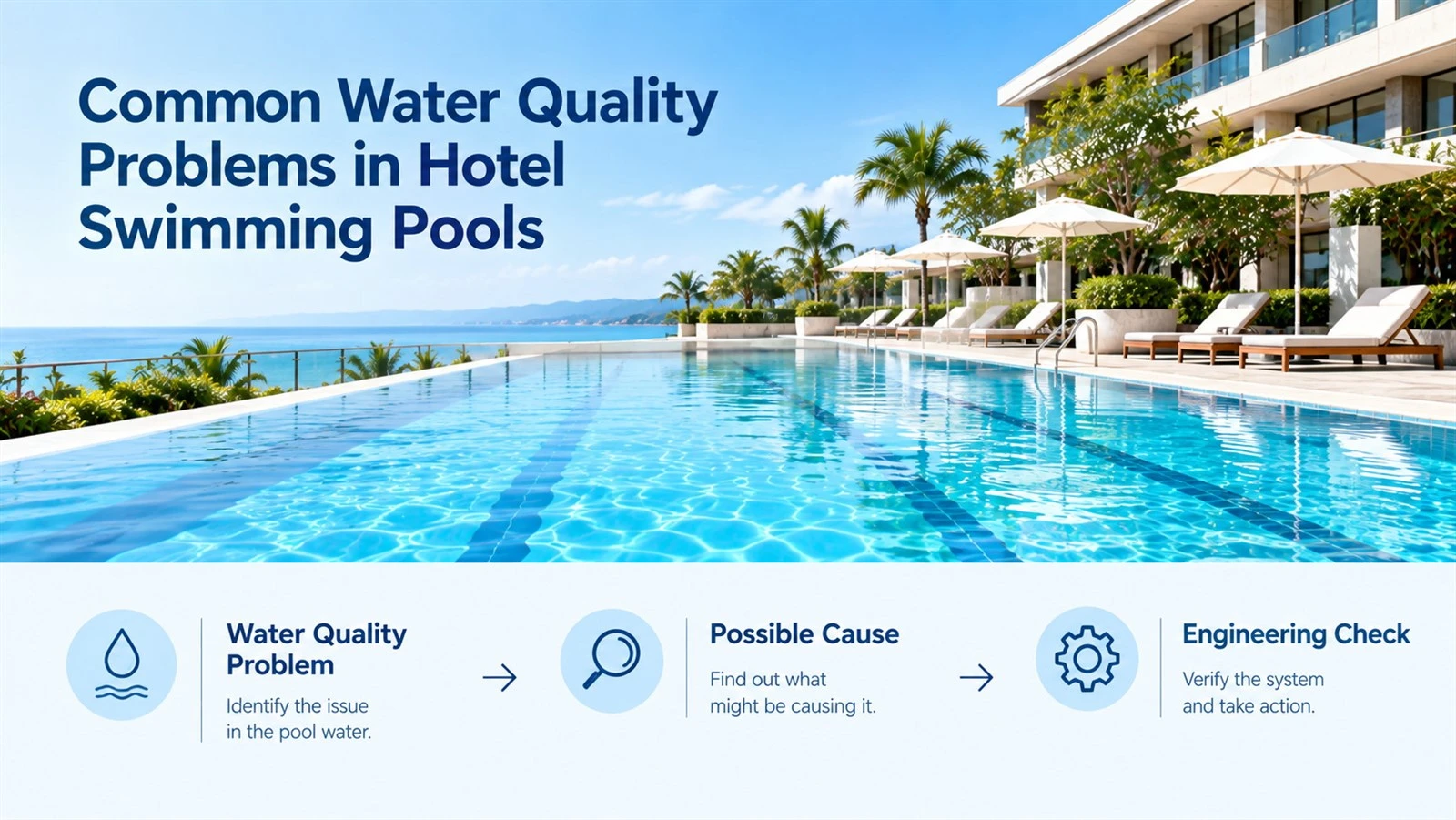
Common Water Quality Problems in Hotel Swimming Pools
Hotel swimming pools are used by different numbers of guests every day. Water quality can change quickly during busy periods, especially when the pool operates for long hours.
Most water quality problems are not caused by one piece of equipment. They are usually related to bather load, circulation, filtration, disinfection and water chemistry.
Here are some of the problems commonly seen in hotel swimming pool projects.
Cloudy Pool Water
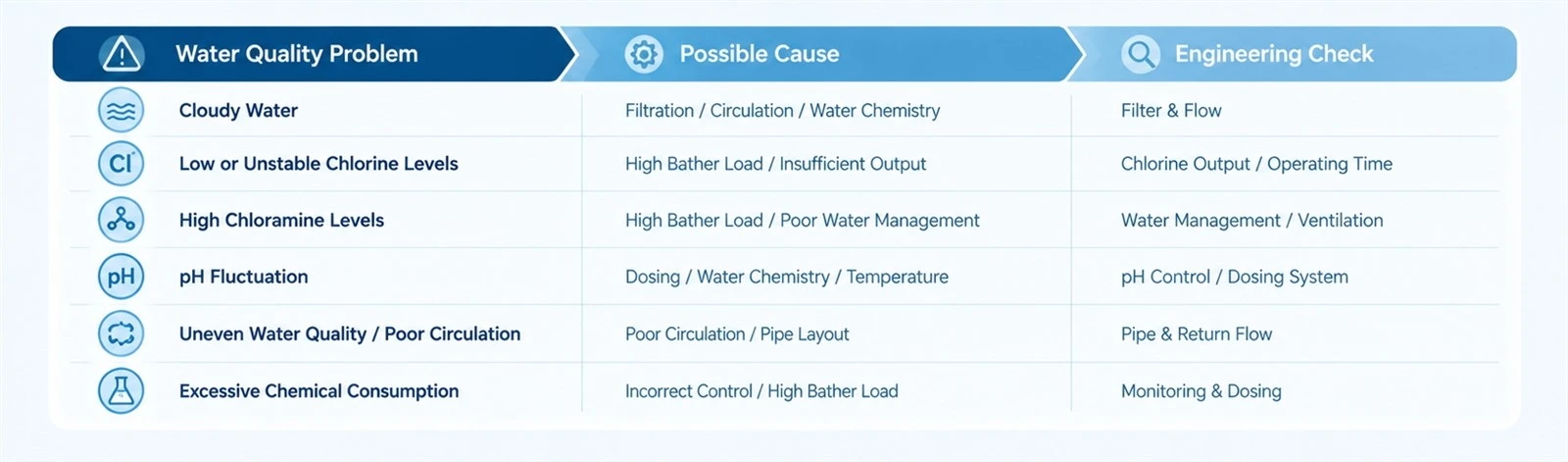
Cloudy water is one of the most visible problems for hotel operators.
Common causes include:
High bather load
Insufficient filtration
Poor circulation
Unbalanced water chemistry
Insufficient disinfection
Fine particles remaining in the water
The first step is to check the circulation and filtration system.
If the filter is working correctly but the water remains cloudy, the project team should then check disinfection capacity and water chemistry.
Project Tip:
Do not solve cloudy water simply by increasing chemical dosage. The filtration and circulation conditions should be checked first.
Low or Unstable Chlorine Levels
Hotel pools can experience large changes in chlorine demand.
For example, chlorine demand may increase during:
Weekends,Holidays,Peak hotel occupancy,Swimming lessons,Events or group activities
If chlorine production or dosing capacity is too low, the residual chlorine level can drop during these periods.
Possible causes include:
Insufficient chlorine output,Short equipment operating time,High bather load,Poor circulation,Incorrect dosing settings,Water chemistry problems
For commercial pools, chlorine production or dosing should be considered based on peak operating conditions, not only average pool use.
High Chloramine Levels
Chloramines can form when chlorine reacts with nitrogen-containing contaminants introduced into pool water.
They are particularly relevant to indoor pools because they can also affect indoor air quality.
High chloramine levels may be associated with:
High bather load,Poor water management,Insufficient fresh-water replacement,Inadequate ventilation in indoor pools,Poor control of water chemistry
Good circulation, filtration, primary disinfection and appropriate secondary treatment can all be part of the overall solution.
For some hotel projects, UV or AOP may be considered as an additional treatment process.
pH Fluctuation
pH affects how pool water behaves and also influences chlorine performance.
pH can change because of:
Swimmer load,Chemical dosing,Fresh-water replacement,Water temperature,Incorrect dosing control
Manual testing can identify the problem, but it does not continuously control it.
For commercial hotel pools, an online monitoring and automatic dosing system can continuously monitor parameters such as pH, ORP and residual chlorine, then adjust the treatment process when necessary.
Poor Water Circulation
Even when the disinfection equipment has sufficient capacity, poor circulation can still cause water quality problems.
Typical signs include:
Some areas of the pool become cloudy,Water quality differs between areas,Dead zones around corners or steps,Uneven chemical distribution,Difficulties maintaining consistent water quality
The circulation system should therefore be considered during the initial pool design rather than after the water quality problem appears.
Pump capacity, pipe layout, return inlets, filtration and turnover should be considered together.
Excessive Chemical Consumption
Some hotel pools consume more chemicals than expected.
This does not always mean that the disinfectant system is inefficient.
Possible reasons include:
High swimmer load,Excessive water replacement,Poor circulation,Incorrect dosing settings,Unbalanced pH,Insufficient filtration,Outdoor sunlight exposure
Before increasing chemical dosage, it is better to identify where the additional demand is coming from.
Automation can also help reduce unnecessary manual dosing by adjusting treatment according to measured water conditions.
How Should a Hotel Pool Water Quality Problem Be Checked?
A practical troubleshooting sequence is:
Water Quality → Circulation → Filtration → Disinfection → Monitoring → Control
For example, if chlorine is low, check the actual chlorine demand and circulation conditions before simply increasing the output of the chlorinator.
If the water is cloudy, check filtration and circulation before adding more chemicals.
This approach helps avoid treating the symptom instead of the cause.
Building a More Stable Hotel Pool System
A hotel pool water treatment system normally needs several parts working together:
Circulation Pump
Moves pool water through the treatment system.
Filtration System
Removes suspended particles from the water.
Disinfection System
Controls microorganisms through salt chlorination, chemical dosing or other suitable treatment methods.
Water Quality Monitoring
Monitors parameters such as pH, ORP, residual chlorine and temperature.
Automatic Control
Adjusts dosing or treatment equipment according to actual water conditions.
For larger or more demanding projects, additional treatment such as UV or AOP can be considered according to the project requirements.
What Should Be Checked During Project Design?
Before selecting equipment for a hotel pool, the engineering team should confirm:
Pool volume
Maximum bather load
Daily operating hours
Water temperature
Indoor or outdoor conditions
Required circulation rate
Filtration capacity
Disinfection capacity
Equipment room space
Water monitoring requirements
Local regulations
A system designed around these conditions is easier to operate than one selected only according to the pool's volume.
Final Takeaway
Common hotel pool water problems include cloudy water, unstable chlorine, high chloramine, pH fluctuation, poor circulation and excessive chemical consumption.
In most cases, the solution is not simply adding more chemicals.
The better approach is to look at the complete system:
Circulation → Filtration → Disinfection → Monitoring → Automatic Control
For hotel and resort projects, HYGOOL can configure swimming pool water treatment systems based on the actual pool conditions, including filtration, salt chlorination, sodium hypochlorite generation, water quality monitoring and automatic control.