


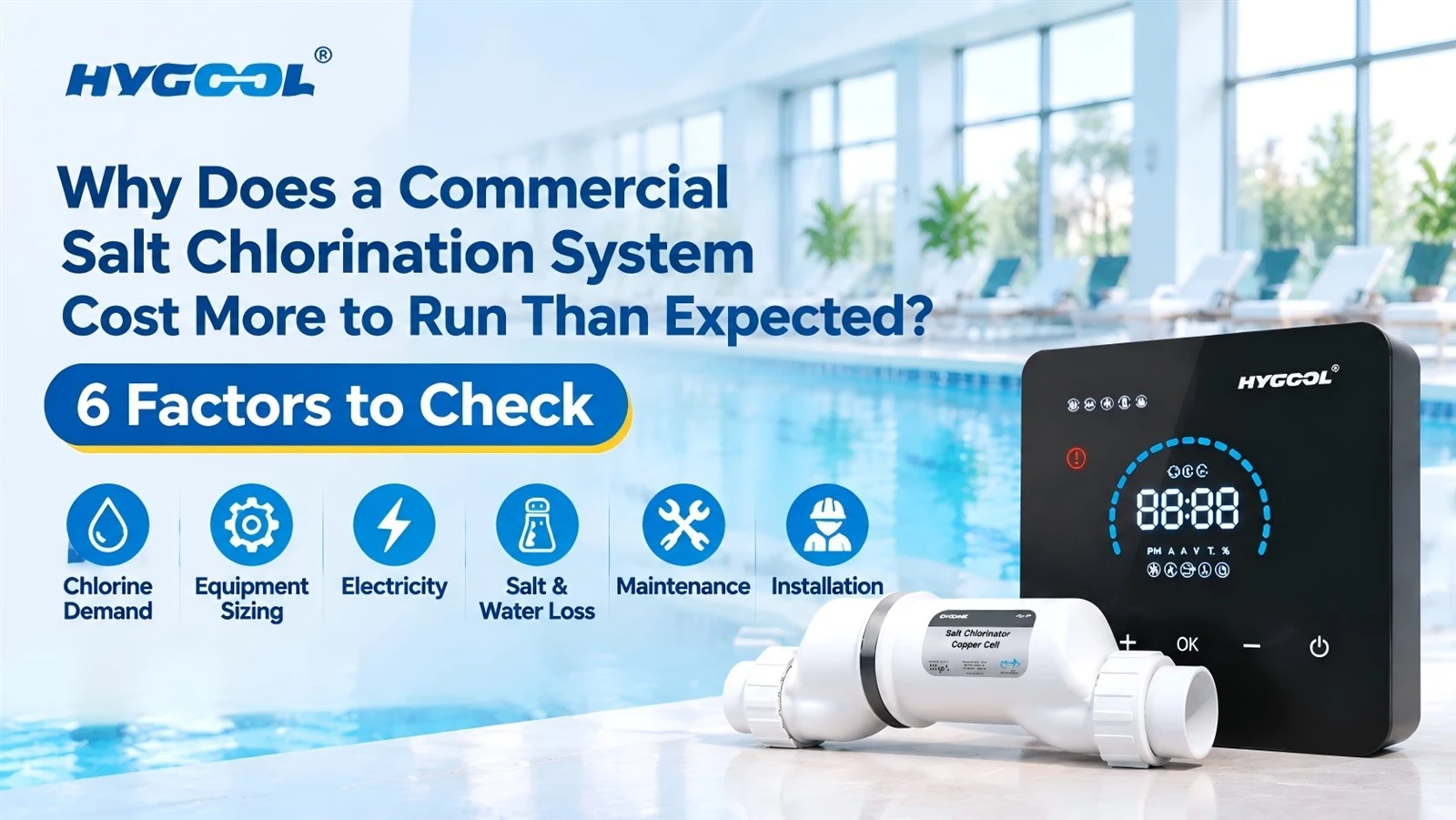
For commercial swimming pools, actual operating costs depend on chlorine demand, generator capacity, operating hours, electricity consumption, maintenance, and replacement parts.
A system that is incorrectly sized or poorly maintained may cost more to operate than expected, even if the initial equipment price is attractive.
So, what drives the operating cost of a commercial salt chlorination system?
Here are six factors project owners and pool engineers should evaluate before selecting equipment.
Chlorine Demand: The Starting Point of Operating Cost
Chlorine demand is one of the most important factors affecting salt chlorinator operating costs.
A commercial pool's chlorine demand changes according to several conditions:
Pool volume and water conditions
Daily bather load
Indoor or outdoor environment
Sunlight exposure
Water temperature
Organic contaminants introduced by swimmers
A pool with high visitor traffic may consume more chlorine than a similar-sized pool with lower usage.
If chlorine demand is underestimated, the generator may need to operate for longer periods or may struggle to maintain the required free chlorine level.
What to check:
Evaluate actual chlorine demand rather than selecting a salt chlorinator based only on pool volume.
For commercial projects, consider normal and peak operating conditions when determining the required chlorine production capacity.
Equipment Sizing: Is the Generator Capacity Appropriate?
Generator capacity directly affects how long the equipment needs to operate to meet chlorine demand.
A unit with insufficient rated output may need extended operating hours. On the other hand, selecting an unnecessarily large system may increase the initial investment without providing meaningful operational benefits.
When choosing a commercial salt chlorinator, consider:
Rated chlorine production (g/h)
Actual daily chlorine demand
Required operating hours
Recommended salt concentration
Operating temperature range
Required water flow
Expected future pool usage
It is important to compare rated chlorine output under the manufacturer's specified test conditions.
Engineering recommendation: Select equipment based on calculated chlorine demand and actual operating conditions. Do not use pool volume alone as the basis for model selection.
Operating Hours and Electricity Consumption
A salt chlorinator uses electricity to drive the electrolysis process.
Its electricity consumption is influenced by operating time, electrical input, output settings, and equipment design.
For example, a generator operating for longer periods will generally consume more electricity than the same equipment operating for fewer hours under comparable conditions.
However, the circulation pump also consumes electricity and should be evaluated separately.
For a complete pool system, electricity costs may include:
Salt chlorinator power consumption
Circulation pump operation
Filtration equipment
Automatic dosing equipment
Other water treatment accessories
What to check:
Review the rated electrical input and expected operating schedule of each device.
When estimating the total operating cost, distinguish between the electricity consumed by the salt chlorinator and the electricity required by the pool circulation system.
Salt Consumption and Water Management
A salt chlorinator uses dissolved salt as the raw material for chlorine generation.
Under normal operation, salt is not consumed in the same way as chlorine. However, salt concentration can decrease through water replacement, backwashing, splash-out, leakage, and other water losses.
Additional salt may therefore be required to maintain the manufacturer's recommended operating range.
Salt consumption depends on pool operation and water management practices.
What to check:
Recommended salinity range of the selected model
Actual pool salt concentration
Frequency of backwashing
Water replacement and splash-out
Leakage or other water losses
Avoid adding salt based only on an equipment alarm. Measure the actual salinity and follow the manufacturer's operating instructions.
Maintenance and Electrolytic Cell Replacement
Maintenance is another important part of long-term operating cost.
The electrolytic cell is a key component of a salt chlorinator. Its performance and service life can be affected by electrode coating quality, operating conditions, scale buildup, water balance, and maintenance practices.
Potential maintenance costs include:
Cell inspection and cleaning
Electrode or cell replacement
Controller and electrical component maintenance
Connection and fitting inspection
Routine system servicing
Some salt chlorinators use reverse polarity to help reduce scale buildup on the cell. However, self-cleaning functions do not eliminate all maintenance requirements.
Cleaning should always follow the manufacturer's instructions. Unnecessary or aggressive cleaning may damage the electrode coating.
What to check:
When comparing products, ask about electrode materials, coating specifications, replacement costs, cell structure, and spare parts availability.
A modular design that allows individual components to be replaced may also help simplify maintenance and reduce unnecessary replacement of complete assemblies.
Installation and System Design: Hidden Costs to Consider
The equipment itself is not the only factor affecting project cost.
Poor installation planning may result in additional maintenance work, system modifications, or unexpected operating problems.
For commercial pool projects, engineers should consider:
Suitable installation space
Correct pipe connections
Required water flow and flow protection
Electrical installation and safety
Maintenance access
Compatibility with existing circulation equipment
Control system integration
For example, installing an electrolytic cell in a location with insufficient maintenance clearance can make routine inspection more difficult.
Similarly, incorrect flow conditions may affect equipment operation and protection.
A well-planned installation helps avoid unnecessary service work and improves long-term system management.
How to Estimate the Operating Cost of a Commercial Salt Chlorinator
Before purchasing equipment, project owners can use a simple cost framework.
| Cost category | Information required |
|---|---|
| Electricity | Rated power input and daily operating hours |
| Salt | Initial salt requirement and additional salt from water losses |
| Maintenance | Inspection, cleaning, and servicing frequency |
| Replacement parts | Electrode cell and other component replacement costs |
| Installation | Electrical, pipework, and integration requirements |
| Circulation system | Pump and filtration electricity consumption |
A simplified annual cost calculation is:
Annual electricity cost = Power consumption (kW) × Operating hours per year × Electricity price per kWh
For example, the electricity cost of the salt chlorinator should be calculated separately from the circulation pump and other pool equipment.
The final operating cost should also include maintenance and replacement parts.
This approach gives project owners a clearer understanding of the total cost rather than comparing products only by purchase price.
How to Reduce the Long-Term Cost of a Salt Chlorination System
There is no single adjustment that guarantees lower operating costs. However, several practical measures can help improve system efficiency.
1. Select the correct generator capacity
Match chlorine production to the pool's actual chlorine demand and operating schedule.
2. Maintain balanced pool water
Monitor pH, salt concentration, and other required water parameters to support normal equipment operation.
3. Keep circulation and filtration in good condition
Correct water flow and effective filtration help maintain stable pool operation.
4. Follow the manufacturer's maintenance instructions
Inspect the electrolytic cell and clean it only when required.
5. Consider replacement and service costs before purchasing
Compare electrode replacement methods, spare parts availability, and after-sales support.
HYGOOL Salt Chlorinators for Commercial Pool Applications
HYGOOL develops and manufactures salt chlorinators for swimming pool applications, with a focus on electrode service life, product structure, and maintenance convenience.
Our product design includes:
Modular construction for easier component replacement
Split structure for convenient installation and servicing
Quick-connection design
Electrode design focused on service life
OEM/ODM customization support
With in-house R&D and manufacturing capabilities, HYGOOL supports distributors, contractors, and commercial pool project partners with product configuration and technical assistance.
When selecting a salt chlorinator, we recommend evaluating not only the initial purchase price but also chlorine output, operating conditions, maintenance requirements, and long-term replacement costs.
Planning a commercial pool disinfection project?
Contact HYGOOL to discuss salt chlorinator capacity, product configuration, and OEM/ODM cooperation.
Frequently Asked Questions
1. What is the biggest operating cost of a commercial salt chlorinator?
There is no single cost that applies to every pool. Electricity, maintenance, electrode replacement, and system operating hours all contribute to the total cost.
2. Does a salt chlorinator consume salt every day?
Salt is not consumed in the same way as chlorine. However, salt can be lost through backwashing, splash-out, leakage, and water replacement, so additional salt may be required.
3. Does a larger salt chlorinator always cost more to operate?
Not necessarily. Operating cost depends on actual electrical consumption, operating hours, output settings, and maintenance requirements. Equipment should be selected according to the pool's chlorine demand.
4. How can I reduce salt chlorinator maintenance costs?
Choose suitable equipment, maintain balanced pool water, ensure correct flow conditions, and follow the manufacturer's cell inspection and cleaning instructions.
5. Is the purchase price the most important factor when choosing a salt chlorinator?
No. Buyers should also compare rated chlorine output, operating conditions, electricity consumption, electrode replacement costs, spare parts, and technical support.