


When buying a salt chlorinator, price is often one of the first things distributors, pool equipment suppliers, and project buyers compare.
However, two salt chlorinators with similar prices may have very different chlorine outputs, electrode designs, operating requirements, and maintenance costs.
Choosing the right salt chlorinator requires more than comparing the product price or appearance. Buyers should understand the technical specifications behind the equipment and evaluate whether the manufacturer can provide reliable product support.
So, what should you check before purchasing a salt chlorinator?
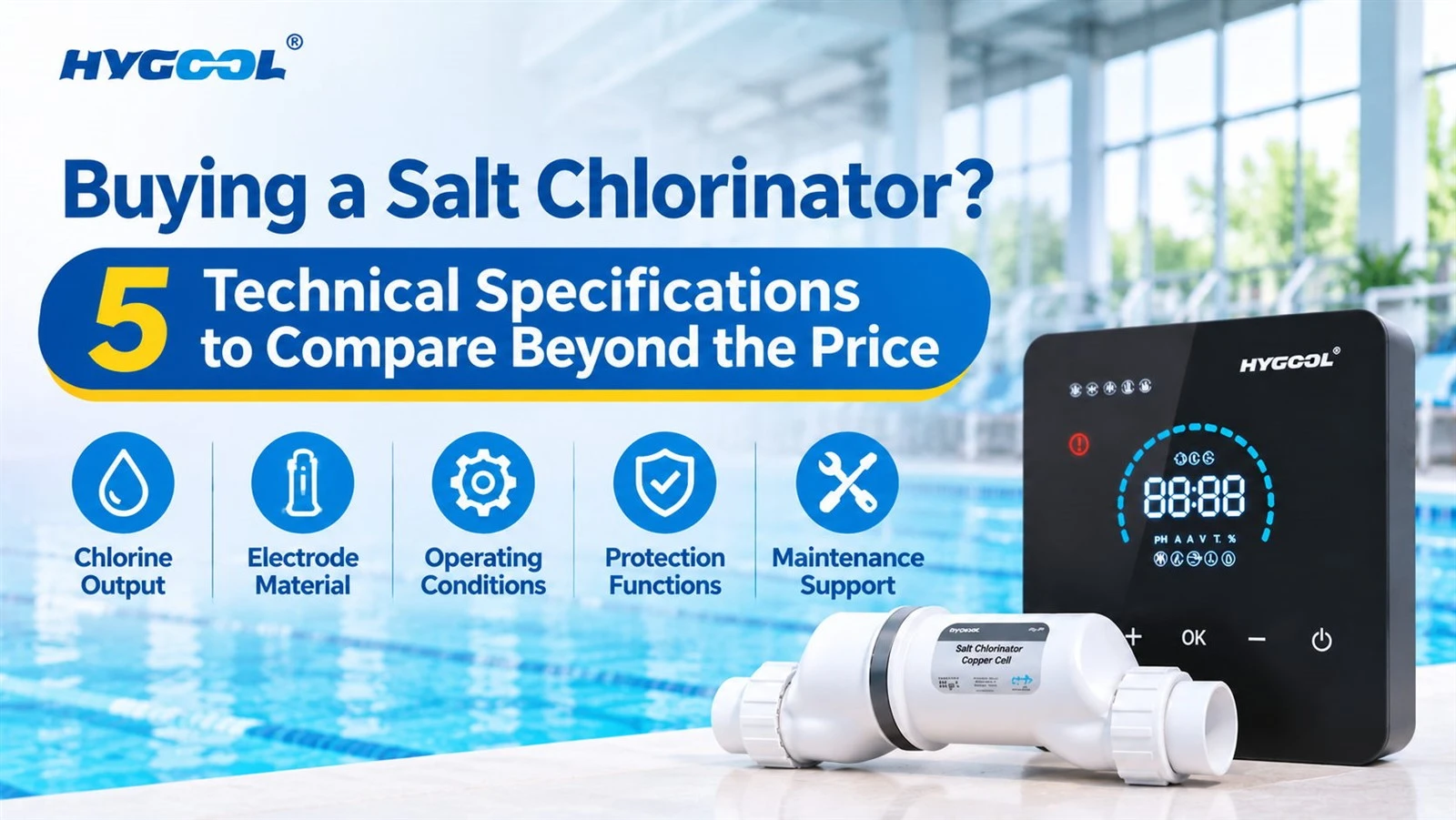
Here are five important technical specifications to compare.
Rated Chlorine Output: Does the Capacity Match Your Application?
Chlorine output is one of the most important specifications of a salt chlorinator.
It indicates how much chlorine the equipment can produce under specified test conditions, usually expressed in grams per hour (g/h).
A higher output does not automatically mean a better product. The required capacity depends on the pool's chlorine demand, operating hours, water conditions, and usage.
Before choosing a model, consider:
Pool volume and actual chlorine demand
Daily operating hours
Expected bather load
Indoor or outdoor pool conditions
Required chlorine production
Manufacturer's rated output conditions
For commercial applications, equipment selection should be based on calculated chlorine demand rather than pool volume alone.
What to ask the manufacturer:
What is the rated chlorine output in g/h?
Under what test conditions is the output measured?
What operating range is recommended?
Are different output configurations available?
Comparing these details helps buyers avoid selecting equipment that is either undersized or unnecessarily large.
Electrode Material and Coating: What Is the Electrolytic Cell Made Of?
The electrolytic cell is the core working component of a salt chlorinator.
It uses electrical energy to convert dissolved salt in pool water into chlorine through electrolysis.
Electrode materials, coating technology, manufacturing quality, and operating conditions all influence cell performance and service life.
When comparing different salt chlorinator manufacturers, buyers should pay attention to:
Electrode base material
Electrode coating type
Coating manufacturing process
Cell structure and design
Recommended operating conditions
Replacement method and spare parts availability
Electrode service life should not be judged by a single advertised number.
Actual performance also depends on operating hours, water chemistry, scale buildup, flow conditions, and maintenance practices.
What to ask the manufacturer:
Request information about electrode materials, coating specifications, maintenance requirements, and replacement procedures.
A manufacturer with in-house R&D and production capabilities may also be better positioned to discuss product design details and customized configurations.
Operating Requirements: Salt Concentration, Water Flow, and Temperature
A salt chlorinator must operate within its specified water conditions.
Different models may have different requirements for salt concentration, water flow, and operating temperature.
These specifications are important because unsuitable operating conditions may affect chlorine production, trigger equipment protection, or contribute to abnormal operation.
Before purchasing, compare the following:
| Specification | What buyers should confirm |
|---|---|
| Salt concentration | Recommended operating range |
| Water flow | Required flow conditions |
| Water temperature | Permitted operating range |
| Installation | Pipe connection and installation requirements |
| Protection | Flow and temperature protection functions |
Do not assume that all salt chlorinators use the same salt concentration or flow requirements.
Always request the manufacturer's technical datasheet and installation manual for the specific model.
For distributors and OEM buyers, clearly documented operating requirements also make it easier to prepare product manuals and provide technical support to end customers.
Control and Protection Functions: Is the Equipment Easy to Operate?
A salt chlorinator should not only generate chlorine. It should also provide suitable control and protection functions for its intended application.
Depending on the model, useful functions may include:
Chlorine output adjustment
Operating status display
Flow protection
Temperature protection
Alarm indication
Automatic operating control
These functions help operators understand equipment status and identify abnormal operating conditions.
However, buyers should distinguish between standard functions and optional configurations.
For example, a basic salt chlorinator may provide local output adjustment, while a more advanced system may support additional control interfaces.
What to ask the manufacturer:
Which protection functions are included?
How are alarms displayed?
Can the output be adjusted?
Are external control connections available?
Can the control configuration be customized?
For commercial projects, control compatibility should be confirmed during system design rather than assumed from the product description.
Maintenance Structure and Replacement Costs: What Happens After Purchase?
The initial purchase price does not represent the full cost of owning a salt chlorinator.
Electrolytic cells and other components may require inspection, maintenance, or replacement during the equipment's operating life.
A practical product structure can make these tasks easier.
When comparing salt chlorinators, consider:
Whether the electrolytic cell is easy to inspect
Whether individual components can be replaced
Whether the product uses a modular structure
Whether connections are convenient to install and maintain
Whether spare parts are available
Whether the manufacturer provides technical support
A modular design may allow individual components to be replaced when required, instead of replacing an entire assembly.
This can make maintenance more practical, depending on the product structure and the nature of the fault.
Buyers should also ask for clear maintenance instructions and recommended inspection procedures.
Why Choose a Salt Chlorinator Manufacturer with R&D and Production Capabilities?
For distributors, importers, and swimming pool equipment brands, working directly with a manufacturer can offer advantages beyond product purchasing.
A manufacturer with its own R&D and production capabilities can provide more direct communication about product structure, technical specifications, and customization requirements.
HYGOOL focuses on the development and manufacturing of swimming pool water treatment equipment.
Our salt chlorinator design focuses on electrode service life and maintenance convenience.
Key design considerations include:
Modular structure: Individual components can be replaced as required.
Split design: Helps simplify installation and servicing.
Quick connection: Supports convenient equipment connection and maintenance.
Electrode design: Focuses on service life and operating performance.
OEM/ODM customization: Supports product configuration requirements for distributors and partners.
With in-house R&D and manufacturing capabilities, HYGOOL supports customers from product configuration discussions to manufacturing and technical assistance.
For buyers looking for a long-term manufacturing partner, product design, production capability, customization, and after-sales support should all be part of the evaluation.
Conclusion: Compare the Complete Product, Not Just the Price
Choosing a salt chlorinator is a technical purchasing decision.
Rated chlorine output, electrode materials, operating requirements, control functions, and maintenance structure all affect whether a product is suitable for its intended application.
Before placing an order, request the technical datasheet, installation instructions, and maintenance information.
A suitable product should match the pool's operating requirements and offer practical support throughout its service life.
Looking for a salt chlorinator manufacturer or OEM/ODM partner?
Contact HYGOOL to discuss product specifications, customization options, and manufacturing cooperation.