


The global private swimming pool market is entering a dual dividend phase of large-scale stock system replacement and incremental capacity expansion. Centered on the United States, the European Union, and Australia, private pool penetration remains consistently high. A large number of newly built residential backyard pools continue to be deployed, while massive volumes of aging pools are undergoing equipment retrofits and system upgrades.
Alongside consumer upgrading at the terminal level, user demands have long moved beyond the basic requirement of "just having water." Instead, they now focus on four core expectations: water safety, hassle-free maintenance, long-term low operating cost, and stable, durable equipment performance.
However, the traditional chemical dosing disinfection model that has been used for decades has always had structural limitations and is unable to meet the experience requirements of modern residential scenarios or the development trends of cross-border trade.
Against this backdrop of industry iteration, salt chlorination electrolysis disinfection technology has rapidly gained adoption, gradually replacing traditional chlorine tablets and liquid chlorine methods, and becoming a standardized global solution for swimming pool maintenance. A disruptive transformation in the swimming pool disinfection industry has now been fully implemented.
▌2. Dual Drawbacks of Traditional Models: Limited End-User Experience and Restricted Trade Distribution
1. C-end (Consumer) Pain Points: Uncontrollable Safety, High Maintenance Cost, Poor User Experience
Traditional chemical disinfection relies entirely on manual dosing. Chemicals are added based on experience, which easily leads to dosage imbalance:
If the dosage is too high, residual chlorine in the pool exceeds safe limits, producing irritating odors and disinfection by-products that continuously irritate human skin, eyes, and respiratory systems, making safety impossible to guarantee. If the dosage is too low, disinfection becomes insufficient, allowing bacteria and algae to proliferate rapidly, resulting in cloudy water and slippery pool walls, ultimately eliminating usability.
At the same time, long-term operating costs under the traditional model remain consistently high. Owners must continuously purchase various disinfectants and water-balancing chemicals, and regularly hire professionals for testing, cleaning, and maintenance. In overseas markets where labor costs are high, these cumulative service expenses become a significant fixed annual burden.
2. B-end (Trade) Pain Points: High Compliance Risk, High After-Sales Cost, Weak Repeat Purchase Formation
From the perspective of cross-border trade and distribution, the traditional "chemical agents + conventional disinfection equipment" model no longer has competitive viability.
On one hand, chlorine tablets and liquid chlorine are classified as hazardous chemicals. Cross-border transportation requires strict regulatory approvals, complex documentation, high logistics costs, and carries significant compliance risks, making large-scale and routine distribution difficult.
On the other hand, most conventional disinfection equipment in the market adopts an integrated all-in-one design without modular architecture. These systems are prone to scaling, calcification, and high failure rates. Once core components are damaged, repair costs are often nearly equivalent to purchasing a new unit.
Due to the geographic dispersion of overseas end users, cross-border after-sales maintenance involves long return cycles and high communication costs, easily triggering customer complaints and brand reputation loss. Although merchants may appear to generate sales, profits are effectively eroded by after-sales losses, making it difficult to establish stable repeat customers or brand loyalty. This model is fundamentally incompatible with the current global swimming pool equipment market trend of high efficiency, low operating cost, and sustainability.
▌3. Salt Chlorinators Become the Industry Mainstream: Qiaoyi Achieves Dual-End Value Creation for End Users and Trade Partners
According to authoritative industry data, the global salt chlorinator market is projected to maintain a compound annual growth rate of approximately 5.35% from 2024 to 2030, demonstrating stable and sustained growth. The core reason is that salt chlorination electrolysis technology fundamentally solves all structural pain points of traditional disinfection methods, making it fully compatible with both residential usage scenarios and cross-border trade requirements. It has become the preferred solution for new pool construction and legacy system upgrades worldwide.
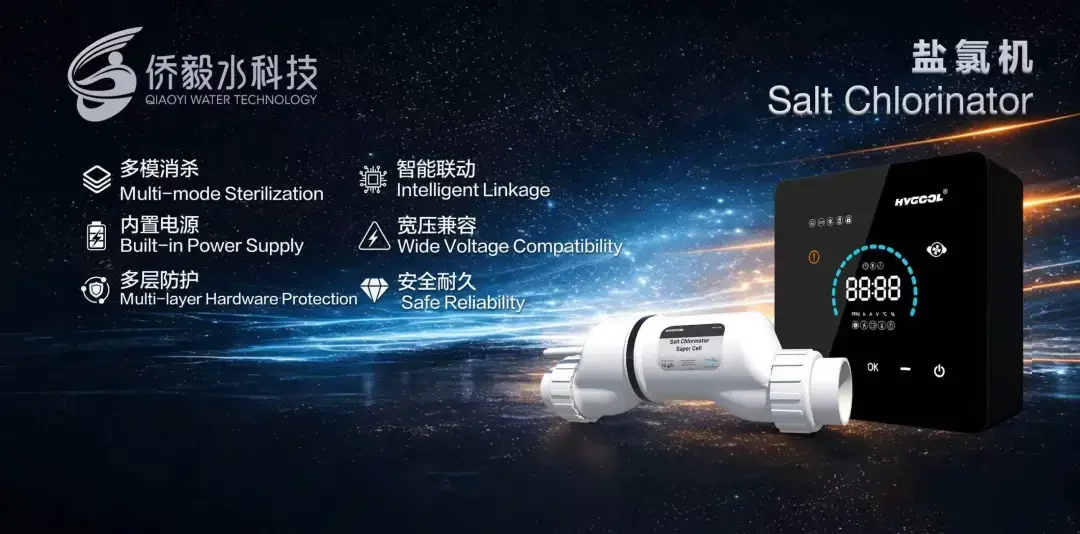
Qiaoyi next-generation intelligent Salt Chlorinator series is developed based on real overseas market demand. Through practical technological upgrades, it delivers dual empowerment: effortless maintenance for end users and profitable scalability for distributors.
For residential pool users, the system eliminates all chemical agents and uses only ordinary salt as the consumable input. Through electrolysis technology, it continuously generates mild hypochlorous acid, achieving 24-hour stable sterilization and algae control. There are no chemical residues and no pungent odors. The water quality remains soft and skin-friendly, fundamentally eliminating health risks.

From a maintenance perspective, it achieves extreme cost reduction and efficiency improvement. Only 3 kg of salt is required per 1 ton of pool water. A single salt addition enables up to six months of long-term disinfection, with only natural water evaporation requiring replenishment. Compared with traditional methods, long-term maintenance costs are reduced by more than 70%.
With automated alarm functions and power-off memory intelligence, the system operates fully unattended, requiring no frequent manual monitoring or adjustment. It is suitable for villa pools, homestays, and small clubs, truly achieving safety, convenience, and cost efficiency simultaneously.
For global cross-border traders and distributors, Qiaoyi solves core industry challenges across four dimensions: after-sales service, system compatibility, profit structure, and brand reputation.
The equipment adopts an aviation-grade modular quick-release design, with independently separated core components, enabling a "replace only what fails" maintenance model. No full-unit disassembly is required, and no professional technicians are needed. End users can independently complete repairs, fundamentally resolving the high after-sales cost and long repair cycle issues of traditional equipment. This significantly reduces cross-border after-sales pressure and improves customer repurchase rates.
At the same time, the system is equipped with a 100–240V global wide-voltage compatibility architecture, supporting electrical standards across multiple countries and regions including the United States, Europe, and Australia. No external transformer is required. One device can serve the global market, effectively reducing inventory pressure and distribution costs for distributors.
In terms of equipment quality and stability, the product integrates high-end titanium electrodes with electrode polarity reversal systems, combined with automatic descaling and pump-linked synchronization technology. This significantly slows down calcification and scaling, extends core component lifespan, and ensures overall failure rates are well below industry averages.
The global swimming pool industry upgrade trend is now clearly defined:
Traditional manual chemical disinfection is accelerating toward obsolescence, while intelligent salt chlorination is becoming the absolute mainstream.
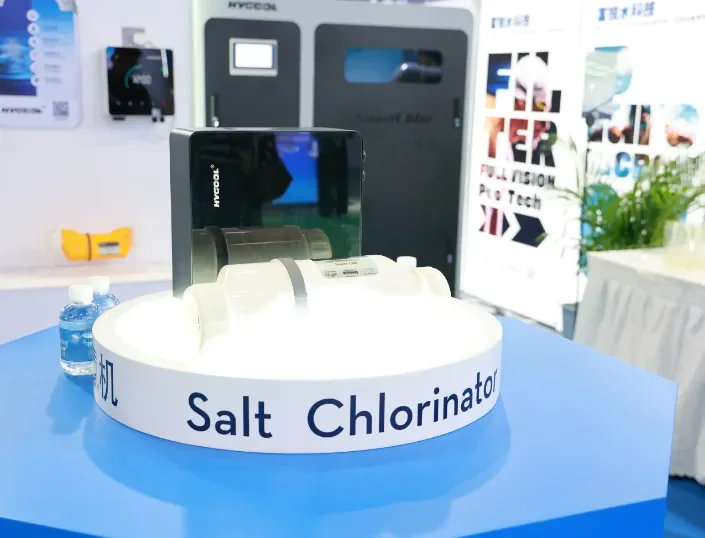
Anchored in real overseas market demand, Qiaoyi focuses on practicality, stability, and deployability. It not only solves end-user pain points such as high maintenance burden, high cost, and safety risks, but also helps trade partners reduce after-sales risks and expand profit margins, enabling global partners to capture emerging blue-ocean opportunities and achieve long-term sustainable revenue growth.