

Hot spring water may contain different levels of minerals, suspended solids, organic matter, and other substances depending on its source. Water temperature is also usually higher, which can affect water quality and treatment requirements.
A suitable system therefore needs to consider the water source, water quality, temperature, circulation, filtration, disinfection, and water replacement strategy together.
For hotels, resorts, hot spring resorts, and commercial spa projects, water treatment should be considered during the early stage of system design.
Start With the Hot Spring Water Source
The first step is understanding where the water comes from.
A hot spring project may use:
Natural hot spring water,Treated groundwater,Mineral water
A combination of hot spring and fresh water
The source water should be tested before selecting the treatment equipment.
Important parameters may include:
pH, turbidity, temperature, hardness, mineral content, iron, manganese, and other site-specific water quality indicators.
The treatment process should then be designed according to the actual water characteristics.
There is no single hot spring water treatment system that is suitable for every project.

Determine the Water Circulation Strategy
A commercial hot spring system normally needs a clear circulation strategy.
A typical circulation process can include:
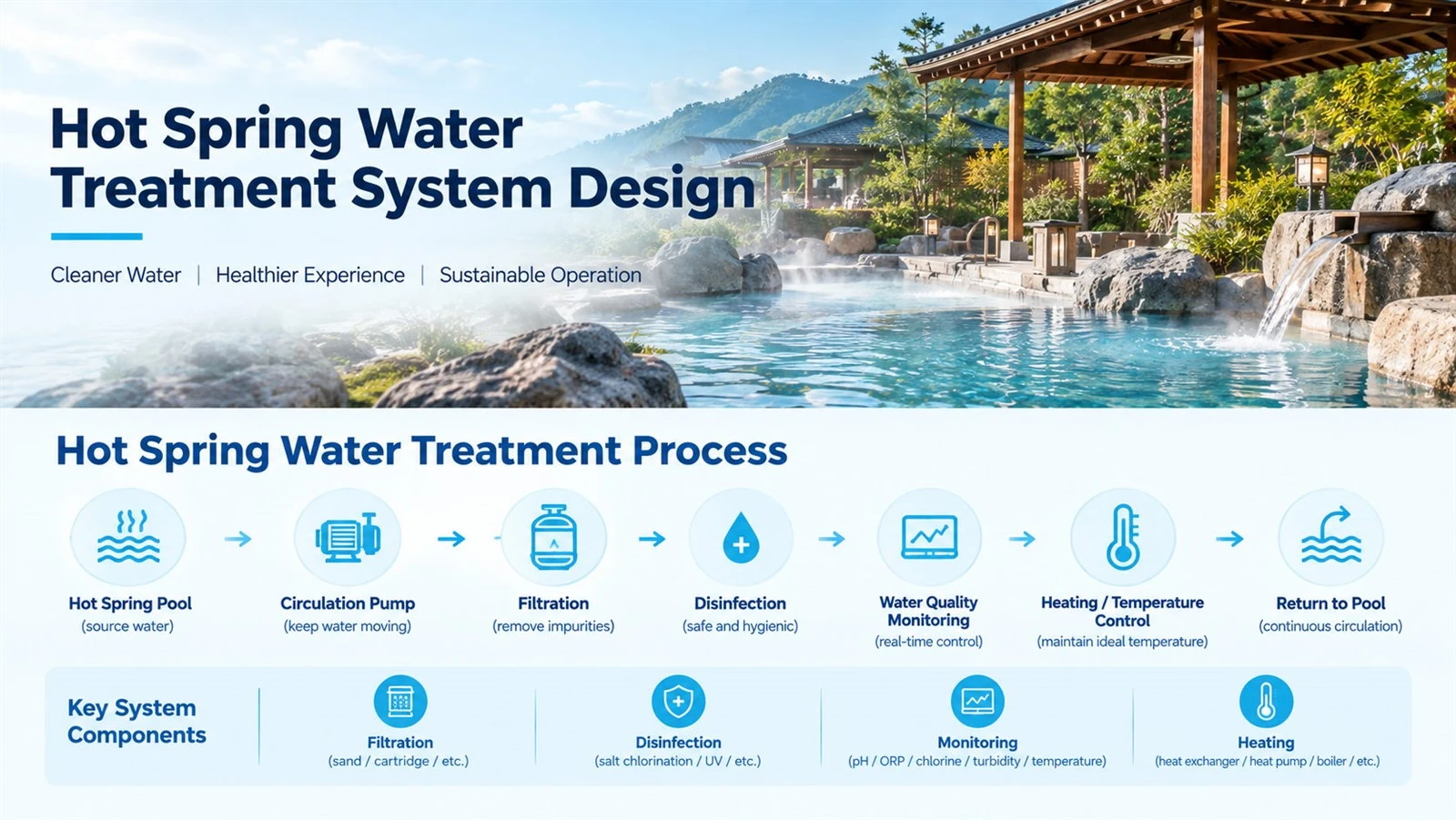
Hot Spring Pool → Circulation Pump → Filtration → Disinfection → Heating / Temperature Control → Water Quality Monitoring → Return to Pool
The actual configuration depends on the pool type and project requirements.
For example, a large hot spring resort may have multiple pools with different temperatures and usage levels. Each pool may therefore require independent circulation and control.
Proper circulation helps maintain more uniform water quality and allows the treatment equipment to operate continuously.
Filtration Is an Important Part of the System
Hot spring water can contain suspended particles and other impurities.
A filtration system helps remove these particles before the water returns to the pool.
Depending on the project, filtration may include equipment such as:
Sand filters
Cartridge filters
Other mechanical filtration equipment
The filter size should be selected according to the pool volume, circulation flow, water quality, and operating conditions.
For commercial projects, the filtration system should also be designed with convenient backwashing, drainage, inspection, and maintenance in mind.
Disinfection Requirements
Hot spring water is used by multiple people, so maintaining appropriate microbiological water quality is essential.
Disinfection can be integrated into the circulation system after filtration.
Depending on the project, the system may use technologies such as:
Salt chlorination
Sodium hypochlorite generation
UV disinfection
Other project-specific disinfection methods
The appropriate method depends on the water characteristics, temperature, pool usage, local regulations, and project requirements.
For a large hot spring project, disinfection should not be considered as an isolated piece of equipment. It needs to work together with filtration, circulation, monitoring, and water replacement.
Water Quality Monitoring and Control
A commercial hot spring project needs continuous attention to water quality.
A water monitoring and control system can be used to monitor parameters such as:
pH, ORP, residual chlorine, turbidity, and temperature, depending on the project configuration.
The monitoring system can also be integrated with equipment such as circulation pumps, dosing pumps, filtration systems, drainage valves, and temperature control equipment.
This allows operators to understand the operating condition of the system and respond when water quality or equipment conditions change.
For larger projects, centralized monitoring can also make daily operation easier.
Temperature Control Is Different From a Swimming Pool
Temperature is one of the defining characteristics of a hot spring project.
The system may need to maintain different temperatures for different pools, such as:
Hot spring pools,Warm pools,Hydrotherapy pools,Spa pools,Cooling pools
The heating system and circulation system therefore need to be considered together.
Depending on the project, temperature control may use heat exchangers, heat pumps, boilers, or other heating equipment.
The final solution should consider the available heat source, required temperature, flow rate, energy consumption, and operating schedule.
Fresh Water and Water Replacement
Water replacement is another important part of hot spring system design.
The replacement strategy depends on:
Source water quality,Pool usage,Water temperature,Water quality requirements,Local regulations,Operating costs
A system may combine continuous circulation and filtration with controlled water replacement.
For commercial hot spring projects, drainage and fresh-water supply should be considered during the initial engineering design rather than added later.
A Complete Hot Spring Water Treatment System
A typical commercial hot spring water treatment system may include:
Water Source
↓
Hot Spring Pool
↓
Circulation Pump
↓
Filtration
↓
Disinfection
↓
Water Quality Monitoring
↓
Heating / Temperature Control
↓
Return to Pool
Additional equipment can be incorporated according to the project requirements.
The final design should be based on the actual site conditions rather than using a fixed equipment package for every project.
How to Design a Hot Spring Water Treatment System
Before designing the system, the engineering team should collect several key pieces of information:
1. Pool information
Pool volume, number of pools, dimensions and water depth.
2. Water source
Natural hot spring water, groundwater, municipal water, or mixed water.
3. Water quality
pH, turbidity, temperature, hardness, mineral content and other relevant parameters.
4. Operating conditions
Daily operating hours, expected number of users and seasonal variations.
5. Temperature requirements
Target temperature for each pool and available heating source.
6. Local requirements
Applicable water quality standards, health regulations and project specifications.
These factors provide the basis for selecting circulation, filtration, disinfection, monitoring and heating equipment.
Conclusion
A hot spring water treatment system should be designed as a complete circulation and water quality management system, rather than as a collection of individual pieces of equipment.
The most important considerations include:
Water Source → Water Quality → Circulation → Filtration → Disinfection → Monitoring → Temperature Control → Water Replacement
For hotels, resorts, hot spring resorts and commercial spa projects, an integrated design can make equipment selection, installation, operation and maintenance more manageable.
The final system should always be adapted to the actual water quality, pool configuration, operating conditions and local requirements of the project.