

Chlorine controls disinfection.
pH affects water balance and chlorine performance.
For a commercial pool, both need to be monitored as part of the overall water treatment system.
Why Chlorine and pH Need to Be Controlled Together
Chlorine demand changes with pool usage.
A busy hotel or public pool can have much higher chlorine demand during peak hours than during quiet periods.
At the same time, pH can change because of:
Swimmer load
Chemical dosing
Fresh-water replacement
Water temperature
Pool operating conditions
If chlorine is controlled without considering pH, the disinfection process may not perform as expected.
This is why commercial pool systems normally monitor both parameters.
How Is Chlorine Controlled?
There are several ways to supply chlorine to a commercial pool.
Salt Chlorination
A salt chlorinator produces chlorine from salt dissolved in the pool water.
The chlorine output can be adjusted according to the pool's requirements.
Chemical Dosing
A dosing pump adds chlorine-based disinfectant into the circulation system.
The dosing rate can be adjusted manually or through an automatic control system.
Sodium Hypochlorite Generation
A sodium hypochlorite generator produces disinfectant on site and feeds it into the circulation system.
The appropriate method depends on the project requirements and operating conditions.
How Is pH Controlled?
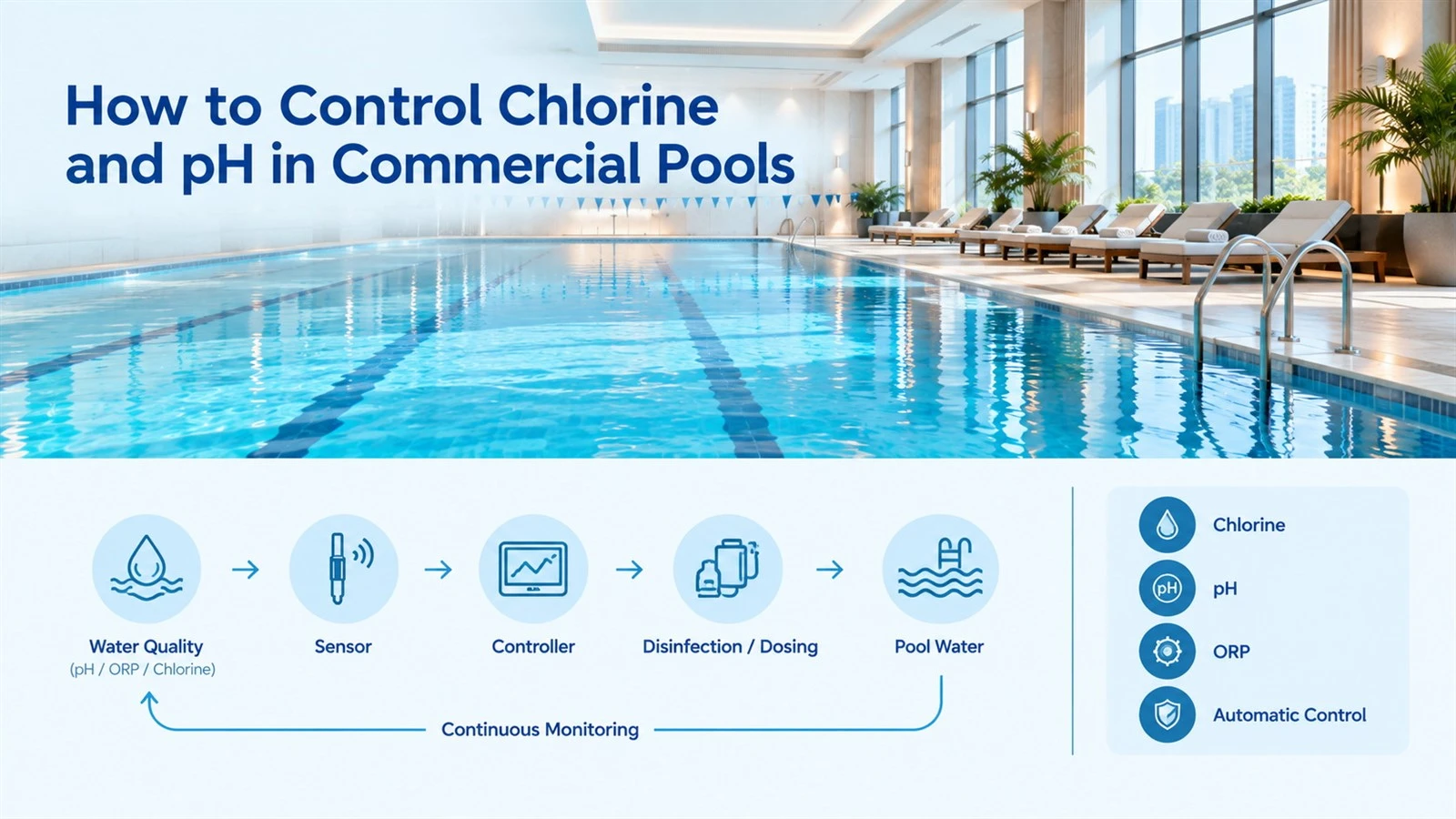
pH is normally controlled through a monitoring and dosing system.
A typical automatic setup includes:
pH Sensor → Controller → Dosing Pump → Pool Water
The sensor continuously measures the water condition.
When the measured pH moves outside the configured control range, the controller can activate the dosing system.
The exact chemical used for pH adjustment depends on the system design and local requirements.
What Does ORP Do?
ORP is commonly used in commercial pool water monitoring systems as an indicator related to the oxidation-reduction condition of the water.
It can be used together with chlorine monitoring and other water quality parameters.
A commercial monitoring system may include:
pH,ORP,Residual chlorine,Temperature,Turbidity
These measurements give the operator a clearer picture of the water condition than checking chlorine alone.
Manual vs Automatic Control
Manual testing still has a role in pool operation.
However, checking the water only at certain times can miss changes that happen between tests.
For example, a public pool may experience a significant increase in swimmers within a short period.
An automatic system can monitor water continuously and respond to changes more quickly.
A typical control cycle is:
Measure → Compare → Adjust → Monitor
This does not eliminate maintenance. Sensors still need calibration, dosing equipment needs inspection, and water quality should still be checked according to the applicable operating requirements.
What Can Cause Chlorine Levels to Drop?
Low chlorine can have several causes.
Check:
Increased bather load,Short operating time,Low chlorine output,Incorrect dosing,Poor circulation,Low salt concentration,Cell scaling,Water chemistry,Outdoor sunlight exposure
Simply increasing chlorine output may not solve the problem if the actual cause is poor circulation or a treatment system that is not operating correctly.
What Can Cause pH to Fluctuate?
pH instability may be related to:
Incorrect dosing,High swimmer load,Fresh-water replacement,Chemical balance,Sensor problems,Poor control settings
If pH changes repeatedly, check the sensor, dosing system and water chemistry rather than continually increasing chemical dosage.
What Should Project Engineers Consider?
Before designing an automatic chlorine and pH control system, consider:
Pool volume
Maximum bather load
Operating hours
Circulation flow
Filtration capacity
Disinfection method
Required monitoring parameters
Chemical storage and dosing
Sensor installation
Equipment room layout
Maintenance access
Local regulations
The monitoring and dosing system should be designed together with the circulation and filtration system.
HYGOOL Commercial Pool Water Quality Control
HYGOOL provides equipment for commercial pool water treatment and monitoring.
Depending on project requirements, the system can include:
Salt chlorinator
Sodium hypochlorite generator
Online water quality monitoring equipment
pH / ORP monitoring
Automatic dosing
Intelligent control system
Circulation and filtration equipment
The configuration can be adjusted according to the pool application, treatment capacity and required level of automation.
For OEM/ODM projects, monitoring and control functions can also be discussed according to the target market and system requirements.
Final Takeaway
Chlorine and pH should not be treated as two completely separate tasks.
Chlorine provides disinfection, while pH control helps maintain suitable water chemistry and chlorine performance.
For commercial pools, a practical approach is to combine:
Monitoring + Disinfection + Dosing + Automatic Control
The system should respond to actual water conditions rather than relying only on fixed chemical dosing.