

Start With the Pool Conditions
Before selecting equipment, collect the basic project information:
Pool volume /Water temperature/Maximum bather load/Operating hours/Indoor or outdoor location/Water features/Fresh-water replacement/Available equipment room space
These conditions determine the required circulation, filtration and disinfection capacity.
A small spa with heavy daily use may require more treatment capacity than its water volume initially suggests.
Circulation Is the Starting Point
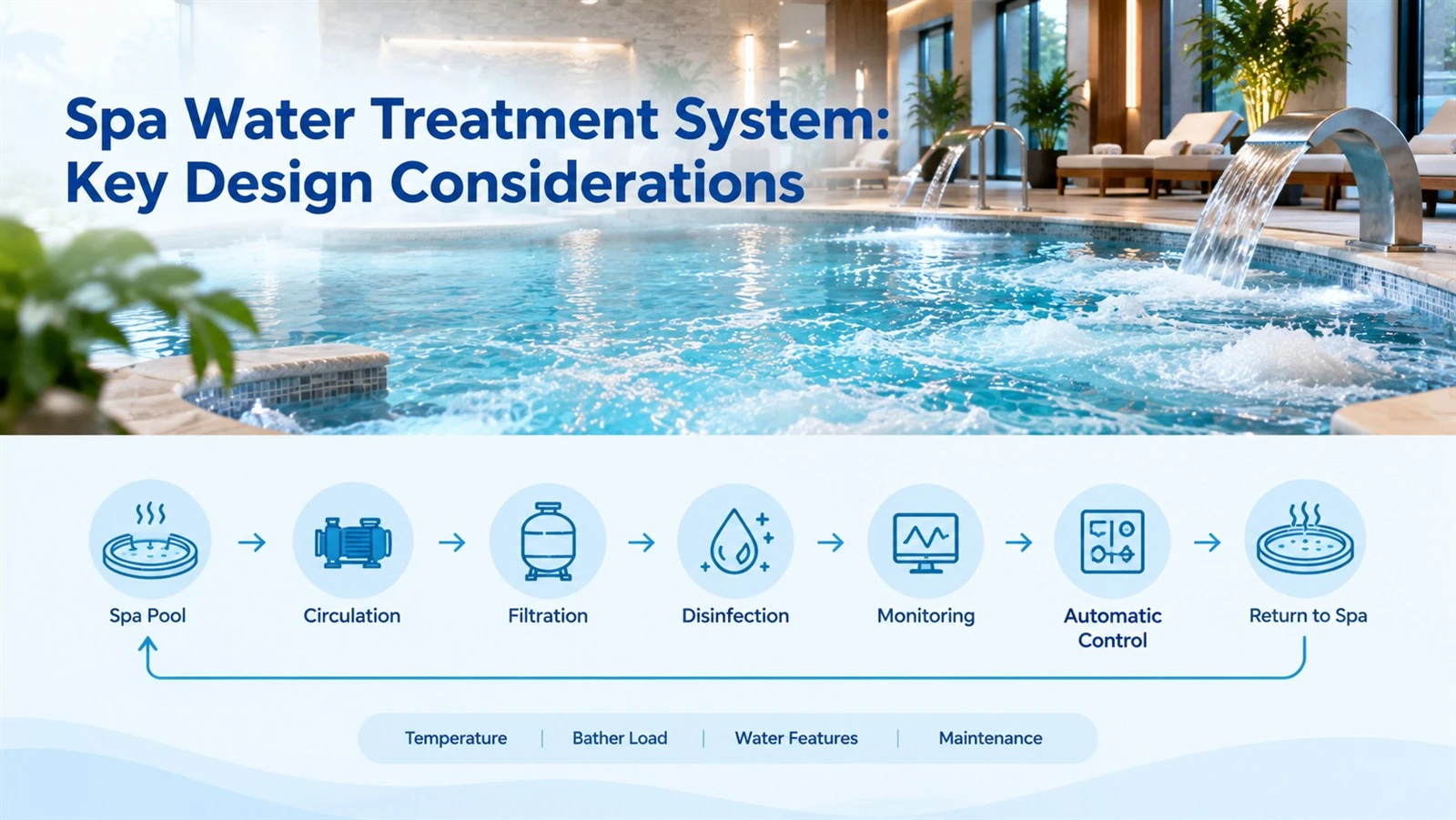
A spa water treatment system normally follows a basic process:
Spa Pool → Circulation → Filtration → Disinfection → Monitoring → Return
The circulation system needs to move water through the treatment equipment at a suitable rate.
For spa projects with massage jets or other water features, the circulation and feature systems should also be considered separately where necessary.
Poor circulation can result in areas where treated water does not mix evenly with the rest of the pool.
Project Tip:
Do not select the circulation pump only from the pool volume. Check the complete hydraulic system, including pipework, filters, fittings and water features.
Filtration Needs to Match the Spa
Filtration removes suspended particles and helps maintain water clarity.
The filter selection depends on:
Water volume
Circulation flow
Bather load
Operating hours
Available equipment room
Maintenance requirements
A filter that is too small may require frequent cleaning and can increase operating pressure.
The filter should therefore be selected together with the circulation pump rather than treated as a separate component.
Disinfection Is More Demanding at Higher Temperatures
Warm water changes the operating conditions of a spa.
Higher temperatures and frequent bathing can increase the demand on the disinfection system.
Depending on the project, the primary disinfection system may use:
Salt chlorination
Sodium hypochlorite
Chemical dosing
Additional treatment such as UV or AOP can also be considered where the project requires it.
The important point is to calculate the disinfection capacity according to actual use, rather than simply selecting equipment according to pool volume.
pH and Chlorine Need Continuous Attention
For a commercial spa, manual testing alone may not provide enough information during busy operating periods.
An online monitoring system can be used to monitor parameters such as:
pH,ORP,Residual chlorine,Temperature,Turbidity
The information can then be used by an automatic control system to adjust dosing or disinfection.
The basic control process is:
Measure → Compare → Adjust → Monitor
This becomes particularly useful when the number of users changes throughout the day.
Water Temperature Matters
Temperature is one of the key differences between spa and standard swimming pool projects.
It affects the operating conditions of the water treatment system and should be considered when selecting equipment.
The design should also consider:
Heating capacity
Heat loss
Operating temperature
Pool cover
Indoor environmental conditions
Fresh-water replacement
For a spa project, water treatment and temperature control should be planned together.
Water Features Can Change the Design
Many spa projects include:
Massage jets
Waterfalls
Air injection
Hydrotherapy features
Multiple connected pools
These features can affect water circulation and equipment selection.
The engineering team should determine whether the feature circulation and treatment circulation can share the same system or should be designed separately.
This is especially important when several spa pools operate at different temperatures.
Common Problems in Spa Projects
Some problems appear repeatedly during operation.
Cloudy Water
Possible causes include high bather load, insufficient filtration or poor circulation.
Unstable Chlorine
Check chlorine production or dosing, operating time, bather load and water chemistry.
pH Fluctuation
Check the monitoring sensor, dosing system and chemical balance.
Excessive Chemical Consumption
Look at the actual water demand before simply increasing the dosing rate.
Uneven Water Quality
Check circulation, return flow and the layout of the pipework.
The equipment itself may not be the problem. In many cases, the issue starts with system design or operating conditions.
Equipment Room Design
The equipment room should be considered at the beginning of the project.
Leave enough space for:
Circulation pumps
Filters
Disinfection equipment
Monitoring equipment
Dosing pumps
Electrical control panels
Valves and pipework
Maintenance access
A system may work correctly on paper but become difficult to maintain if the equipment is packed too closely together.
For commercial projects, access to the filter, pump and salt cell should be considered during layout design.
A Practical Spa Water Treatment Configuration
A typical configuration may include:→
Circulation Pump → Filtration → Disinfection → Water Quality Monitoring → Automatic Control → Spa Pool
Depending on the project, the system can also include heating, UV/AOP and automatic dosing.
The final configuration should be based on the pool's actual operating conditions.
What Should Be Confirmed Before Equipment Selection?
For a spa project, the engineering team should confirm:
Pool volume ∕ Water temperature ∕ Maximum bather load ∕ Operating hours ∕ Circulation flow ∕ Filtration capacity ∕ Disinfection method ∕ Monitoring requirements ∕ Heating requirements ∕ Water feature configuration ∕ Equipment room conditions ∕ Local regulations
This information gives the equipment supplier enough information to configure the system properly.
HYGOOL Spa Water Treatment Solutions
HYGOOL provides equipment for spa and commercial water treatment projects, including:
Salt chlorinators
Sodium hypochlorite generators
Water quality monitoring equipment
Automatic dosing systems
Circulation and filtration equipment
Intelligent control systems
The equipment can be configured according to the project's pool conditions, treatment requirements and level of automation.
For project-based applications, the complete treatment process should be considered rather than selecting individual products separately.
Final Takeaway
A spa water treatment system needs to deal with more than water volume.
Temperature, bather load, circulation, filtration, disinfection and monitoring all affect the final system design.
The most practical approach is to start with the actual operating conditions and then select the equipment around them.
For a commercial spa project, good water treatment design should make the system stable to operate, straightforward to maintain and suitable for the way the spa is actually used.